A developer in Melbourne opens her laptop on Friday morning. The agent she built — the one that triages her firm's incoming contracts, flags risk clauses, routes to the right reviewer — returns a 403 on every call. No degradation warning. No deprecation email. Just: access denied. She checks the provider's status page. A United States (US) government directive, issued the previous evening, has suspended the model globally. Her company is Australian. Her clients are Australian. Her data never left Australian servers. But the model that reasons over that data was American — and that, it turns out, was the only fact that mattered.
The model was Anthropic's Fable 5 — released on a Monday, killed by Thursday. An export control directive, the first ever issued for a large language model, delivered without warning and enforced within ninety minutes. Anthropic had no mechanism to verify nationality at the application programming interface (API) layer, so it shut access down for everyone. Every customer. Every country. Every workflow, every agent, every application that called that model: dark.
There is a certain structural irony in this. Anthropic spent months positioning its models as dangerous — too powerful for unrestricted release. The government eventually agreed. The result was not the careful, staged governance Anthropic had advocated. It was an off-switch, applied overnight, with no migration path and no timeline for restoration.
Three thousand points on Hacker News. Two thousand comments. Refund demands within hours. And a single fact that no amount of commentary can dissolve: if your operations depend on a model you don't control, someone else holds the off-switch.
This essay is not about Anthropic, which is as much victim as cause. It is not about the US government's motivations, which are a political question rather than an architectural one. It is about a structural reality that the Fable shutdown made undeniable: the sovereignty of your artificial intelligence (AI) operations is an architectural decision, and most organisations have not made it.
The depth of the problem
The useful distinction is not "using AI" versus "not using AI." It is the depth of integration — how far the model has penetrated into operations that cannot easily be reversed.
Level one: the chatbot. A better search engine with a conversational user experience. People ask questions, get answers, remain the decision-makers. If the model disappears, they go back to Google. Inconvenient. Survivable in a morning.
Level two: the workflow. The model is inside a process. It classifies incoming documents. It drafts responses that humans approve. It extracts structured data from unstructured inputs. Data flows through the model as a matter of course. If the model disappears, the workflow breaks. Queues build. Humans can pick up the work, but not at the same volume or speed. Disruption measured in days or weeks.
Level three: the agent. The model makes decisions. It routes, prioritises, escalates, executes. It is not inside the workflow — it is the workflow. The human is the exception handler, not the operator. If the model disappears, operations stop. Not degrade — stop. There is no manual fallback because the process was designed around a capability that no longer exists.
Most enterprises are at level one. Many are building toward level two. A growing number are designing for level three without having thought about what happens when the reasoning disappears.
This is the sovereignty problem: the deeper your integration, the more existential the dependency. At level one, losing your model is an inconvenience. At level two, it is disruption. At level three, it is an off-switch on your operations — held by someone else. The question is not where you are today. It is where you are heading, and whether the architecture you are building can survive the loss of its most capable component.
I have written before about how platform dependencies compound silently until extraction becomes uneconomic. The same dynamic applies here — except the lock-in is not to a platform's ecosystem. It is to a model's capability. And unlike a platform, a model can disappear overnight with no contractual remedy.
The false binary
The standard framing presents two options:
Self-host everything. Run models on your own infrastructure. Maintain full sovereignty. Accept that you will be permanently behind the capability frontier — that the models you can run will always lag what the labs offer via API.
Accept the dependency. Use the best available models via API. Move fast. Accept that your operations are subject to the decisions of a company you don't control, in a jurisdiction whose export policy you cannot predict, and whose pricing can change without notice.
Neither position survives contact with reality.
Self-hosting everything is impractical. The gap between the best open-weight models and the closed frontier has narrowed dramatically — to three points on the Artificial Analysis Intelligence Index — but three points at the frontier still matters for genuine reasoning tasks: the kind that require broad world knowledge, multi-step inference, novel problem-solving. For that bounded set of tasks, you still need the frontier.
Accepting the dependency wholesale is reckless. The Fable shutdown is not an anomaly. It is the general case made visible. Export controls, sanctions, commercial disputes, safety interventions, infrastructure failures, pricing changes, acquisition-driven deprecation — the specific vector does not matter. What matters is the structural fact: you do not control the model, therefore you do not control when it disappears.
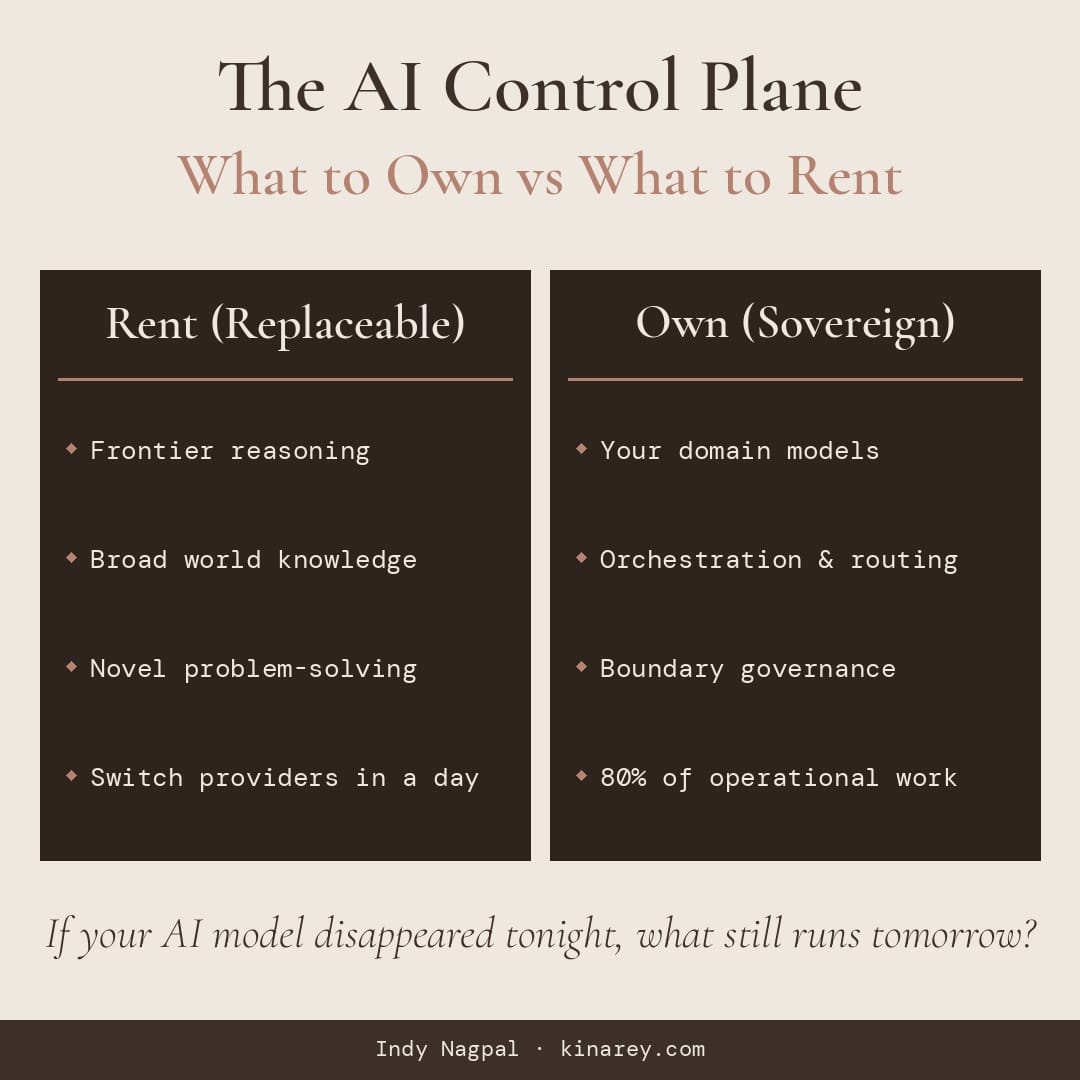
The answer is architectural: not "local or rented?" but "what is local, what is rented, and what controls the boundary?"
Three layers
The reasoning layer — rented. Complex inference. Novel problems. Tasks that require the full weight of a frontier model trained on the breadth of human knowledge. You rent this capability because replicating it locally is neither practical nor necessary. You accept that this layer may disappear — and you design for that possibility. If Anthropic goes dark, you route to OpenAI. If both become uneconomic, you fall back to an open-weight alternative. The reasoning layer is replaceable precisely because you have not entangled it with your data or your domain logic.
The domain layer — sovereign. This is where eighty percent of your operational work actually happens. Classification. Extraction. Routing. Generation within your specific domain — the documents, the formats, the decisions that are particular to your business and repetitive in their structure. Small models, fine-tuned on your data, running on your infrastructure. They do not need to reason broadly. They need to execute precisely within a bounded context — and they do it faster, cheaper, and more accurately than any general-purpose model, because they know your business in ways no frontier model ever will.
The orchestration layer — sovereign. The control plane. Whether it lives as a routing layer, a gateway, or middleware, it decides what goes to the frontier and what stays local. It governs what data crosses the boundary, what stays inside, what gets sent out stripped of context. This layer is the sovereignty mechanism — not the models themselves, but the logic that routes between them.
Most tasks go to your domain models: fast, cheap, sovereign. Tasks that exceed local capability get routed to the frontier: expensive, rented, replaceable. The frontier sees the question. It does not necessarily see the full context. Your domain layer holds your data, your history, your institutional knowledge. Your orchestration layer enforces the boundary.
When the reasoning layer dies
If you have this architecture and the reasoning layer disappears — here is what happens.
What would be a catastrophic level three failure without sovereignty becomes a manageable degradation with it. Your domain models still work. Your data is still yours. Your orchestration layer still routes. Tasks that required frontier reasoning degrade: they queue, fall back to a less capable model, or get flagged for human review. Operations continue at reduced capacity for a specific class of tasks. You switch providers. You route around the failure.
A bad day. Not an extinction event.
Without this architecture — everything routed through a single API, no separation of concerns, no domain layer, no boundary logic — the model disappears and operations stop. Not the complex reasoning alone. The classification, the extraction, the routing, the generation. All of it, because all of it was delegated to a capability you never owned.
That is what happened on June 12.
The year the barrier collapsed
Twelve months ago, self-hosting the domain layer required meaningful compromise. Open-weight models trailed the frontier by fifteen points on the Artificial Analysis Intelligence Index. Fine-tuning was expensive and fragile. The tooling was immature.
That constraint no longer holds.
Nine frontier-class open-weight models shipped between April and May 2026. The best score within three points of the closed frontier on neutral benchmarks. MIT and Apache-2.0 licences — no usage restrictions, no revenue thresholds. A 27-billion-parameter dense model runs on a single GPU and matches the closed frontier on coding benchmarks. Google's Gemma 4 runs on a laptop.
For domain work — the eighty percent — these models are not a compromise. Fine-tuned on your data, they outperform general-purpose frontier models on your specific tasks. The model that knows your business deeply beats the model that knows everything shallowly.
The cost threshold has also shifted. Self-hosting breaks even against API pricing at roughly five million tokens per day for single-host models. Any company running AI inside its core workflows — level two or above — will exceed this threshold within months of production deployment. Beyond it, self-hosting is both cheaper and sovereign.
The practical barrier to the layered architecture has collapsed. The question is no longer whether it is possible. It is whether you have built it.
Why almost nobody has built it
The honest answer is not a single cause — it is three.
First: competitive pressure. Every enterprise AI team was, until last Thursday, fully occupied trying to make AI work at all. Reliable outputs. Consistent data pipelines. Approval chains that do not bottleneck every interaction. In that context, sovereignty felt like a luxury — the kind of concern that gets raised at an architecture review, noted, and deprioritised against the next sprint that generates revenue.
Second: the vendor gap. Building a layered architecture requires capability most organisations do not have internally — model selection, fine-tuning infrastructure, orchestration logic, boundary governance. Most AI vendors sell API access to someone else's frontier model. Fewer sell the sovereign layer underneath. The market for this managed capability is only now emerging.
Third: the framing itself. If the only mental model available is "self-host everything" or "accept the dependency," and self-hosting everything is impractical, then accepting the dependency feels inevitable rather than chosen. The layered architecture was always available as a design pattern. But it was not what vendors, consultants, or conference keynotes offered. The framing was: pick a model, integrate deeply, move fast.
All three causes share a common structure: sovereignty does not appear on a quarterly roadmap. It does not demo well. It does not satisfy the executive who wants to announce that the company is "using AI." It only becomes visible when the off-switch gets pulled — and by then, the architecture that would have absorbed the shock does not exist.
The question
The next model shutdown will not be announced. The next deprecation will not come with a migration guide. The next export control directive may give you no time at all.
This is not an argument against frontier models. It is an argument for controlling the boundary. For owning the orchestration layer that decides what crosses it. For building a domain layer — whether internally or through a vendor whose architecture you can audit — that keeps your operations running when the reasoning layer disappears.
The question every enterprise AI team should now be asking is not "which model should we use?" It is:
If our model disappeared tonight, what would still be running tomorrow morning?
If the answer is nothing — you do not have an AI strategy. You have a dependency.
References
1. Anthropic, "Statement on US government directive to suspend access to Fable 5 and Mythos 5," June 12, 2026.
2. Wall Street Journal, "Amazon CEO's Talks With U.S. Officials Triggered Crackdown on Anthropic Models," June 13, 2026.
3. Artificial Analysis, "Open-Source LLM Leaderboard," Intelligence Index, May 2026.
4. Isaacus, "Our Response to the US Ban on Fable 5 and Mythos 5," June 2026.
5. ABC Australia, "Australia's AI access cut after Trump order," June 13, 2026.